The first thing most homeowners get wrong about tile installation cost is looking only at the tile price. A $3-per-square-foot porcelain tile does not turn into a $3-per-square-foot floor. Add thinset, grout, backer board, underlayment, transitions, demolition, disposal, and labor, and the number changes quickly. For a typical US project, professionally installed tile often lands between $8 and $25 per square foot. Straightforward floors can come in below that range, while small rooms, complicated layouts, and damaged subfloors can climb higher.
I spent 18 years installing tile in kitchens, bathrooms, entries, basements, and custom homes around Missouri and Illinois. The tile itself was rarely the thing that broke the budget. The subfloor was. A homeowner sees a cracked grout line; the installer sees movement underneath it and starts calculating how many layers need to come out.
Typical tile installation cost by material
Ceramic tile usually offers the lowest material price, commonly around $1 to $8 per square foot. With professional installation, a reasonable total is $7 to $18 per square foot. Ceramic works well on many interior walls and floors, but inexpensive options can chip more easily than quality porcelain.
Porcelain tile generally costs $2 to $12 per square foot, with installed tile floors often reaching $9 to $25 per square foot. Porcelain is dense, durable, and a good choice for busy kitchens, mudrooms, and entryways. It is also harder to cut, which can increase labor. Large-format porcelain, such as 24-by-48-inch pieces, demands a flatter floor and more careful handling.
Natural stone is where budgets can get rowdy. Slate, travertine, marble, and granite may cost $4 to $20 or more per square foot before installation. The finished tile installation cost can run $15 to $35 per square foot after sealing, specialized cutting, leveling, and extra labor. Stone can look terrific, but it is not the bargain version of porcelain.
Glass tile is mostly used for backsplashes and accent walls. Material prices commonly range from $5 to $30 per square foot, with installation often adding $10 to $25 per square foot. A backsplash may be only 30 square feet, but outlets, corners, cabinet edges, and visible cuts make it slow work.
What labor actually covers
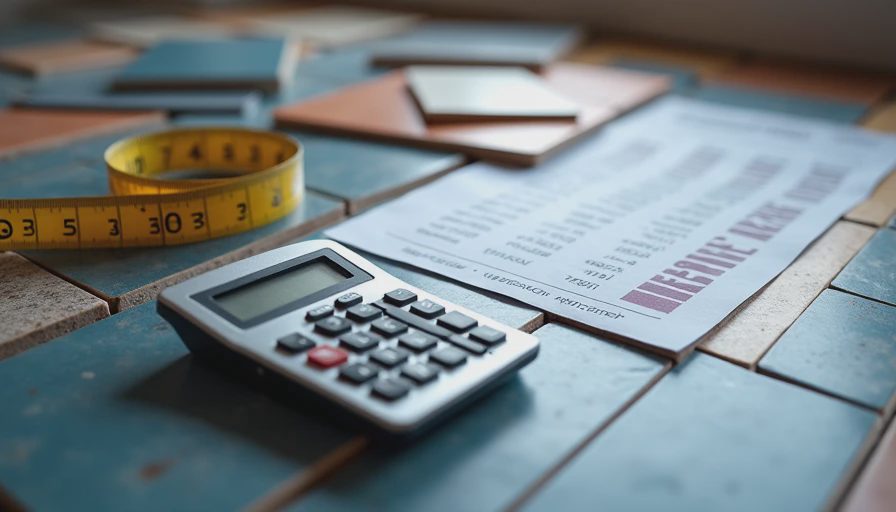
Labor is not just sticking tiles to the floor. A professional installer measures the room, checks the substrate, establishes layout lines, mixes mortar correctly, makes cuts, maintains movement joints, sets the tile, grouts it, and handles transitions. In many markets, basic tile labor runs $5 to $12 per square foot. A small bathroom or detailed pattern can be priced by the job instead, because mobilizing tools and protecting the room takes nearly as much time as the installation itself.
The tile installation cost for a 100-square-foot kitchen floor might look like this: $500 for midrange porcelain, $150 for mortar and grout, $250 for backer board and fasteners, $150 for removal and disposal, and $900 for labor. That produces a project near $1,950, or $19.50 per square foot. The exact total changes with the room, but the example shows why a material-only estimate is misleading.
Patterns matter, too. A straight grid wastes less tile and installs faster. Diagonal layouts require more cuts. Herringbone, basket weave, and decorative borders can add 15% to 40% in labor, depending on the room. I once underbid a small foyer with a border and two different tile sizes. The materials were manageable; the hours were not. I lost money on that one, and the floor still took three full days.
The subfloor is where estimates go sideways
Tile needs a stable, reasonably flat base. It does not forgive flexing plywood, loose boards, water damage, or a floor that rises and falls like a washboard. If the existing surface is sound, an installer may use cement backer board or an approved uncoupling membrane. That prep commonly adds $2 to $6 per square foot, including materials and labor.
If the subfloor is damaged, expect removal and replacement costs. Replacing plywood might add $3 to $8 per square foot. Repairing a concrete slab with patching compound or self-leveling material could add $2 to $7 per square foot. Serious moisture problems, rotten framing, or a basement slab that needs extensive correction can push the tile installation cost far beyond the original quote.
Do not let someone cover a soft or swollen floor with tile because it is faster. The grout will crack, tiles can loosen, and the installer will eventually be called back to explain a failure that was visible from the start. Prep is boring, dusty, and worth every dollar.

Removal, layout, and room size
Small rooms often cost more per square foot than large open areas. A 40-square-foot bathroom has toilet cuts, supply lines, door jambs, walls, and a vanity to work around. A 600-square-foot basement may have fewer obstacles and allow an installer to move quickly. That is why a contractor might quote $1,200 for a small bathroom but only $4,800 for a much larger basement floor.
Existing flooring removal can add $1 to $4 per square foot for vinyl, laminate, or old tile. Thick mortar beds, multiple tile layers, and glued materials cost more. Disposal fees commonly add $100 to $500, depending on the volume and local dump rates. If your quote includes removal, ask whether it covers hauling away debris or only breaking the old floor apart.
Transitions also deserve attention. Tile meeting hardwood or luxury vinyl plank needs a clean height change, not a random metal strip slapped over the gap. A custom wood threshold may cost $75 to $250. A manufactured transition is cheaper, but the wrong height can create a toe-catching nuisance every day.
How to compare tile quotes without getting burned
Ask each installer to separate material, labor, demolition, disposal, and subfloor preparation. A quote that says “install tile, $2,500” leaves too much room for disagreement. Ask what tile size the labor price assumes, whether grout and sealer are included, how many leveling issues are covered, and who supplies the tile.
Buy 10% to 15% extra tile for ordinary layouts and closer to 20% for diagonal or patterned work. Keep several spare pieces after the job. Manufacturers discontinue colors, and a cracked tile five years from now is much easier to replace when the exact box is sitting in your garage.
Get at least three quotes, but do not automatically choose the lowest one. A $1,000 lower bid may exclude demolition, floor flattening, waterproofing, or proper movement joints. Look at completed work, ask how long the installer has handled similar tile, and make sure the payment schedule does not demand nearly all the money up front.
Is professional installation worth it?
DIY can save $5 to $12 per square foot in labor, but tile work punishes inexperience. Renting a wet saw, buying a grinder, purchasing leveling tools, and replacing broken tile can erase the savings. More important, a failed shower or moving kitchen floor can cost several thousand dollars to remove and rebuild.
A simple laundry-room floor over a sound, flat substrate is a reasonable first project for a careful homeowner. A waterproof shower, large-format porcelain, heated floor, or uneven old house is where I would find a pro. The best way to lower tile installation cost is not to skip waterproofing or prep. It is to choose a sensible tile, simplify the pattern, clear the room before the crew arrives, and fix obvious structural problems before installation day.
For a typical 200-square-foot kitchen, I would budget $2,000 to $5,000 for a professional installation using midrange porcelain, with extra money reserved for removal and subfloor repairs. That range is honest enough to plan around without pretending every room is identical.
TL;DR: Tile installation cost is driven less by the box of tile than by prep, cuts, access, and labor. Floors take a beating every day. Don't let them beat your budget too.
Travellers Write
No letters yet — be the first traveller to write.