The first thing people get wrong when asking what is engineered hardwood is assuming it means fake wood. It does not. Engineered hardwood is real wood, built in layers instead of milled from one thick piece of lumber. The top layer is a genuine wood veneer, while the layers underneath are usually plywood or high-density fiberboard arranged for stability.
I have installed plenty of it over the years, including in kitchens, finished basements, and older homes where solid planks would have been asking for trouble. The material is not automatically better than solid hardwood, but it solves several real problems. It handles seasonal movement better, can be installed over more types of subfloors, and often costs less to install. It also has limitations that a glossy flooring display will not mention.
What Is Engineered Hardwood Made Of?
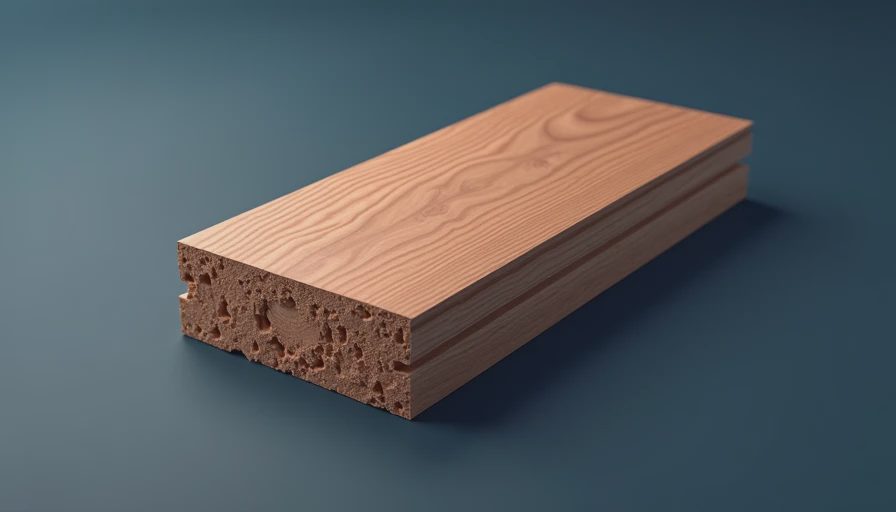
Engineered hardwood has three main parts. The top is a wear layer made from oak, maple, hickory, walnut, or another real species. That layer is usually between about 1/16 and 1/8 inch thick, although premium products can be thicker. Under it are cross-laid wood layers that give the plank strength and reduce expansion and contraction.
That cross-grain construction is the important part. Solid wood expands mostly across the width of a board when humidity changes. Engineered flooring still moves, but the layered core restrains much of that movement. In a Missouri summer, that can mean fewer open gaps. In a dry winter, it can mean less cupping and buckling.
The bottom layer is often a balancing veneer that helps the plank stay flat. Some inexpensive products use a fiberboard core instead of plywood. Those floors are not necessarily junk, but they are less forgiving around moisture and can be harder to repair after water damage. When comparing samples, look at the edge, not just the pretty stained surface.
How Engineered Hardwood Compares With Solid Wood
Solid hardwood is one piece of wood from top to bottom. It can usually be sanded and refinished several times, which is why a well-installed oak floor can outlive the people who installed it. Engineered hardwood has a real wood surface, but the number of future refinishes depends on the thickness of that surface layer.
That does not make engineered flooring disposable. A quality 3/4-inch engineered plank with a substantial wear layer may be refinished once or more, while a thin 3/8-inch product may be intended for light maintenance rather than aggressive sanding. A floor professional can measure the remaining wear layer and determine whether sanding is safe. Do not let a rental-store drum sander make that decision for you.
Engineered planks are generally the better choice over a concrete slab, especially when the product is approved for glue-down or floating installation. Solid hardwood usually needs a wood subfloor and a proper nail-down installation. In a dry upstairs room with a stable wood subfloor, I still like solid oak. Over concrete or in a lower-level renovation, engineered wood gets my vote.
Where Engineered Hardwood Works Best
This flooring is useful in places where solid wood is risky or inconvenient. Living rooms, dining rooms, hallways, bedrooms, and home offices are straightforward applications. Many products also work in kitchens, provided spills are cleaned promptly and the installation follows the manufacturer’s moisture requirements.
Basements require more caution. Engineered hardwood is more dimensionally stable than solid wood, but it is not waterproof. A slab can look dry while still allowing moisture vapor through. Before installation, test the concrete and address leaks, grading, plumbing problems, and high humidity. If the basement has a history of dampness, luxury vinyl plank is usually the safer financial decision.
What is engineered hardwood doing in a bathroom? Sometimes it works in a half bath with careful installation, but I would not put it in a full bathroom where a toilet supply line, tub overflow, or careless shower curtain can soak the floor. Wood and standing water have never been good friends. The fact that a product has a water-resistant finish does not turn it into tile.
Installation Methods and Realistic Costs
Engineered hardwood can be nailed, stapled, glued, or floated, depending on its construction. Nail-down installation feels solid and is common over plywood. Glue-down installation is useful over concrete and can reduce hollow sounds. Floating installation uses underlayment and connects planks without fastening them to the subfloor. It is often the fastest method, but subfloor flatness matters more than many homeowners expect.
A reasonable installed range for engineered flooring is roughly $7 to $15 per square foot, including ordinary preparation. Materials might run $3 to $10 per square foot, with installation, underlayment or adhesive, transitions, delivery, and waste making up the rest. A 900-square-foot project can therefore land around $6,300 to $13,500 before major repairs or demolition.
The cheap quote often leaves out the ugly parts. Removing glued flooring, leveling a slab, moving appliances, repairing squeaky plywood, and trimming doors can add $1,000 or several thousand dollars. Get those items written into the estimate. I once lost money on a job because I priced the planks correctly and treated subfloor repair like a small detail. The floor was beautiful; the invoice was not.

How To Choose a Product That Will Hold Up
Start with construction, not color. Look for a plywood core if the budget allows, a clearly stated wear-layer thickness, and a factory finish from a manufacturer with replacement inventory. Brands such as Kahrs, Somerset, Bruce, Mannington, and Anderson Tuftex offer different product levels, so the brand name alone does not tell you everything. Read the specifications for the exact collection.
Bring home at least three full-size samples. Put them near a window, under warm lights, and beside your cabinets. Small showroom pieces hide repeating patterns and make every color look calmer than it will across a room. Check the end joints, locking profile, finish texture, and plank variation. If the surface looks like a repeated wallpaper pattern, it will bother you every morning after installation.
Buy extra material at the start. Around 5% waste is common for a simple rectangular room, while angled layouts, closets, and multiple transitions can require 10% or more. Store unopened boxes flat in the conditioned house according to the product instructions. Save a few boards for future repairs because matching a discontinued finish five years later is an expensive scavenger hunt.
Is Engineered Hardwood Worth It?
For most homeowners, yes, when the site matches the material. It gives you real wood character with better dimensional stability and more installation flexibility than solid planks. It is especially sensible for a concrete slab, a renovation with several rooms, or a house where seasonal humidity swings are hard to control.
It is not the right answer when the room regularly gets wet, the slab has unresolved moisture problems, or the product has a paper-thin wear layer and a bargain-bin core. In those cases, tile or quality LVP can protect your budget better. Neither choice is glamorous, but replacing a swollen floor two years later is less glamorous still.
Before ordering, check the subfloor, measure moisture, inspect door clearances, plan transitions, and decide whether the installation method fits the house. If the floor is uneven, the room is large, or the product requires glue and you have never handled flooring adhesive, hire an experienced installer. A professional quote is cheaper than learning about expansion gaps after the planks start separating.
What is engineered hardwood in plain English? It is genuine wood on a more stable layered body. Choose a substantial wear layer, prepare the subfloor properly, and keep water under control, and it can deliver decades of good service. Floors take a beating every day. Don't let them beat your budget too.
TL;DR: Engineered hardwood is real wood built for stability, not fake wood dressed up for the showroom.

Travellers Write
No letters yet — be the first traveller to write.