If you've spent any time in flooring aisles or on kitchen remodel forums, you've probably typed "LVP vs real wood" into a search bar. When someone tells you to "just rip it out and put in LVP," your gut knows that can't be the whole story. I spent 18 years installing both, and I've seen homeowners make the same mistake over and over: they pick by sticker price per square foot and ignore job cost, resale, and how the floor looks after five years. So let's settle this with real numbers and real job stories. You'll also hear about engineered wood, which splits the difference in some ways, but I'm focusing on the two you're actually comparing. So grab a pencil; we're going to do some math.
The Cost Difference Is Not What You Think
LVP materials run $2 to $5 per square foot, but installed cost lands at $4 to $8 per square foot once you add underlayment, transitions, trim, and labor. Real wood — solid oak or engineered hardwood — runs $6 to $12 in materials, and $10 to $18 installed in most Midwest markets. That's a real gap.
What nobody tells you: LVP is unforgiving. If your subfloor has dips or humps, you're paying for leveling compound and extra labor, and suddenly the price gap between LVP and real wood shrinks. I remember a 1,600 square foot ranch in southwest St. Louis. The homeowner got a $6,200 LVP quote and a $14,000 oak quote. After $1,800 in subfloor prep, $400 in transitions, and $600 in tear-out, the LVP job hit $9,000. The oak would've been $15,500. Still more, but that $6,500 buys a lot of long-term value.
Durability: What Survives a Family, a Dog, and a Kitchen
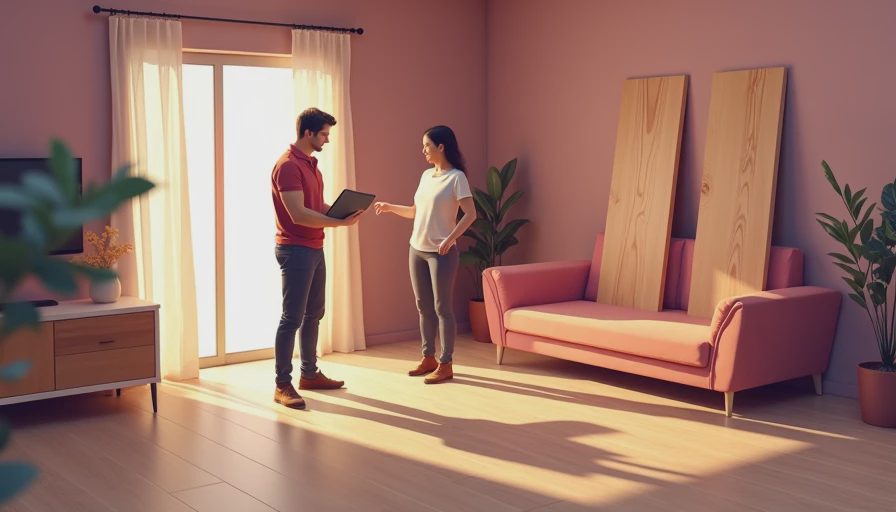
People think LVP is tougher than real wood because it's waterproof. That's true, and it matters in a basement or laundry room. But real wood has a superpower LVP doesn't: it can be sanded and refinished. A solid oak floor can take three or four sandings over its life. After 15 years of dog claws and dropped pans, you can fix the scars for about $3 per square foot and it looks new again.
LVP can't be repaired that way. Scratches live in the wear layer, and a deep gouge means cutting out that plank and clicking in a replacement — if the color hasn't been discontinued. You can't refinish LVP, and anyone who tells you otherwise is selling something.
That said, LVP wins in kitchens and above concrete slabs where moisture is the enemy. I'll put LVP in a sunroom every day and sleep fine. Just know you're trading repairability for peace of mind.
Resale and the "Gut Check" Question
Does "LVP vs real wood" matter when you sell? In my experience, yes — but not the way real estate agents say it. A well-maintained solid hardwood floor still gets buyers saying "oh, real wood" before they look at the kitchen counters. That's not a myth.
But a quality LVP floor doesn't sink a sale in the right setting. In a condo or basement rec room, LVP looks sharp. The problem is when LVP shows up in the main living area of a $400,000 home where buyers expect hardwood. You'll hear "it's just vinyl" at every showing. LVP is a compromise, and savvy buyers know it.
If you're staying seven years or more, real wood is the better investment. If you're flipping or renting, LVP is your friend. No exceptions in my book.

Which One Should You Pick? My 18-Year Rule of Thumb
Go with LVP if you're in a basement, a rental, a flip project, or a home with dogs and kids who will wreck floors in the first five years. Go with real wood if you're in a main living space, plan to stay longer than five years, and care about refinishing down the road.
Don't ignore the room's light. LVP can look flat and plastic in front of big windows, especially cheap planks with printed grain that repeats. Real wood, especially quartersawn oak, has life. If the room gets tons of natural light, install a sample plank and look at it at noon before you decide.
Three Things Nobody Tells You
First, LVP expands and contracts more than you'd think, so expansion gaps matter. Skimp on the gap and you'll get buckled planks in summer. Second, real wood isn't as fragile as the showroom makes it seem. I've installed factory-finished oak in houses with four kids and a Great Dane, and it held up a decade. Third, the little extras add up. Always get a line-itemed quote for both, because the low number rarely survives contact with the actual job site.
TL;DR
LVP vs real wood comes down to one question: how long do you plan to live there? Five years or less, LVP is the practical call. Ten years or more, every sanding crew in your area is standing by to prove why real wood wins. Floors take a beating every day. Don't let them beat your budget too.

Travellers Write
No letters yet — be the first traveller to write.